
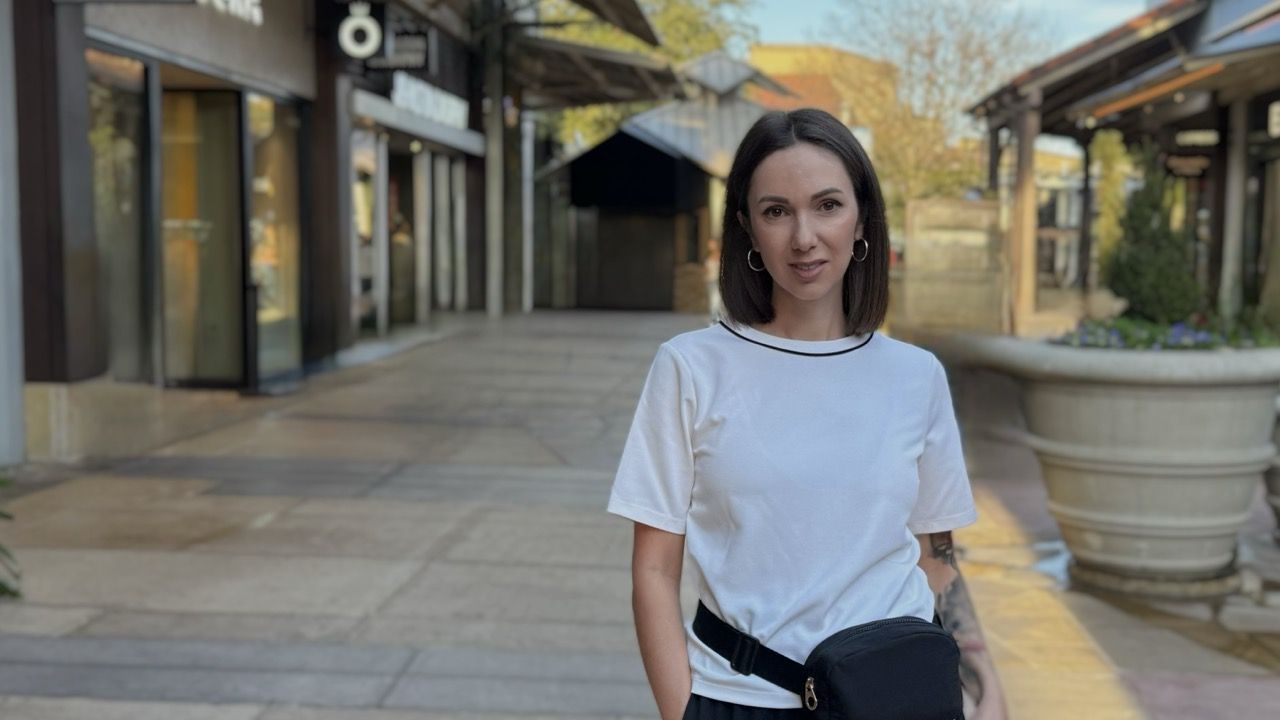
A designer from Ukraine, Anna Petrovska, knows how to make a stage costume comfortable and unique: her author’s technique helps not only athletes, but also brands to create new niche collections.
By Sebastien Girard
The stage costume becomes the most important part of the performance: the world moves to the trend of individual design. According to Market Intelo, the global stage costume market was estimated at $2.45 billion in 2024, with an expectation of growth to $4.35 billion by 2033. Experts attribute this to a sharp increase in the number of vocal, dance, and performance projects, as well as the industry’s shift from mass-produced products to fully customised costumes optimised for the artist’s movement. Not just appearance, but drama and movement are becoming key aspects of clothing.
The designer Anna Petrovska (known on social media as Anita) works in this area. She moved from Ukraine to the USA, and she was one of the first in the world to consciously approach stage costume as an instrument of plasticity and dynamics, rather than just an outfit. Her clients include officials and politicians from Ukraine, as well as athletes from the United States and Europe.
Her works meet the demands of the time: costumes that take into account the range of movements, the interaction with the choreography and the body of the actors. She combines ergonomics and psychophysiology in the design of the costume, creating products that decorate the stage and support the performer’s body in dynamics. Due to this, her costumes withstand a high choreographic load, and her approach helps brands become more unique and grow from a mass market into a niche production.
How a suit can feel the body
The growth of the performative arts has led to a change in the requirements for stage costumes. If the costume used to be a decorative element, today it becomes a part of plastic, movement and image. The design methodology developed by Anna is based on the analysis of the kinetic plasticity of the client and taking into account his reactions. The technique she developed is based on the principles of ergonomics and psychophysiology of movements in the process of creating a stage costume. It involves modelling structural elements not as static forms, but as dynamically adapting to the amplitude and nature of the performer’s movements. This technique solves the problem of limited motor skills and impaired movement of the artist.
Anna Petrovska works in that part of the stage costume industry where the costume becomes an extension of the performer’s body. Her approach was formed from practical observations of how a person behaves in clothes while moving. She notes that the body on stage reacts not only to the construction, but also to the emotional and motor tasks that the artists solve in real time. During fittings, she observes micro-movements, changes in breathing rate, pauses, gaze direction, and weight redistribution – all those non-verbal signals that show where the structure supports movement and where it causes tension. The client may not say in words that she or he feels insecure, but this is reflected in the turns of the body, the position of the shoulders, and stops, which she reads more accurately than any wording.
In addition, her morphotyping system is a comprehensive study of proportions, kinetics, stabilisation points, and the client’s individual movement patterns. For Anna Petrovska, it is important not only to identify a morphotype but also to understand how the body behaves in motion: which areas require unloading, where additional support is needed, and how the centre of gravity shifts during elements or posing. This allows her to design constructions that work in sync with the body rather than against it.
“Morphotyping does not work on photographs or measurements, only with live movement. It is important to be able to see a person as a doctor. If you watch carefully, you can catch nuances that the client himself is unaware of. For example, where fabric restricts motion, or when construction causes stress for the client. It is at these moments that the most accurate professional decisions are made,” Anna commented.
Building on this live, movement-based approach, Anna works not only with clients in person but also successfully adapts her methodology for those at a distance. She demonstrates her author’s techniques in a blog on social networks, which allows her to collaborate with clients from Asia, Europe and the USA. Since not all people are able to travel to the designer for fittings, she developed a remote fitting technology for sewing competition suits that do not require in-person adjustment. « Using this technology, a suit for Miss World was designed and sewn: Irina Keller represented Ukraine at the beauty contest in 2017 wearing this suit, »
Anna said.
A new attitude to fashion in the mass market
Despite the rapid development of digital technologies, they are definitely not used in all production. This is the prerogative of mass markets, which brands are also moving away from in order to move away from the mass into something more unique. One of the Ukrainian clothing brands turned to Anna just to create its own uniqueness and reduce the number of returns.
In Ukraine, Anna ran her own sewing workshop, worked daily with real clients, artists, children and athletes, watching live plastic in hundreds of scenarios. There, in the conditions of practical production, her technique received not only creative, but also technological development: the very foundation that later allowed her to introduce adaptive mass design technology at the Assorti enterprise, clothing supplier in Ukraine.
The methodology of working with this brand was aimed at the formation of patterns adapted to the morphological diversity of consumers. It combines the analysis of anthropometric data of the target audience like types of typical figures, such as height, volume, and possible body features of people of different ages. Also constructive modelling algorithms were analysed, which makes it possible to produce mass collections with the effect of individual planting. This increased the accuracy of the fit of clothes on a larger number of shapes. This technology solves the problem of mass production of clothing, which traditionally focuses on average proportions. As a result of working with Anna, the brand noted the appearance of a collection with a high degree of versatility of fit, a decrease in returns by 11%, and an increase in commercial efficiency, as the process of production fell in price by almost 17%, and logistical processes accelerated by about 20% due to unified product specifications.
“After implementing my authorial methodology, the return rate decreased. This happened because the garments began to correspond more accurately to the parameters of typical body shapes and the real anatomical characteristics of customers, which improved the precision of fit. At the same time, the strategy of fabric unification and adaptive modelling allowed the company to reduce its overall fabric consumption – it was exactly what we aimed to achieve,” Anna Petrovska commented.
From ethnic costumes to international competitions
Anna has refined and adjusted her approach many times while working with different brands and athletes. If the Assorti case was more about calm, everyday fashion, then creating national costumes, for instance, is already a deeply creative process. For the performance in Bulgaria at the international festival Golden Voice, costumes were produced for the vocal studio ‘Talant’, which represented the Ukrainian national team. The looks were developed in an ethno-style with elements of hand embroidery and stylised folk motifs, executed using modern materials such as matte viscose suiting fabric, double-knit fabric with elastane, decorative linen with added polyester, and heat-stable accessories. These fabrics ensured durability, comfort during prolonged wear, and good interaction with stage lighting. At the same time, the requirements for mobility on stage were fully taken into account.
Anna’s unique approach to designing art and the creation of costumes for participants of international festivals and competitions around the world became the reason for her joining the AATCC, the American Association of Textile Chemistry and Coloristics, one of the largest international organisations in the industry, which emphasises professional involvement in the field of materials science and textile technology.
Moreover, in 2025, Anna Petrovska’s professional work received recognition as she was awarded a Certificate of Special Congressional Recognition, presented by Representative Doug LaMalfa, for outstanding leadership and a significant business contribution within the United States. The recognition was granted based on the measurable impact of her methodology for garment construction based on morphotypes and natural human motion. The evaluation emphasised that her system bridges the gap between custom-level precision and scalable manufacturing, contributing to production optimisation and sustainable development within the American fashion industry.
There are more questions in the development of stage costumes today than ready-made solutions: how to take into account individual plastics in mass production, how to combine art design and technology, how to create costumes that work not on stage at all, but with a specific person. Anna Petrovska’s work shows a possible trajectory of the answer. Where industry is moving towards standardisation, it returns attention to the body; where technology is seeking to simplify processes, it shows that precision arises from observation. And it is this balance – between movement and construction, the personal and the mass – that becomes the guideline for what stage costume will be like in the coming years.
Laissez une réponse