
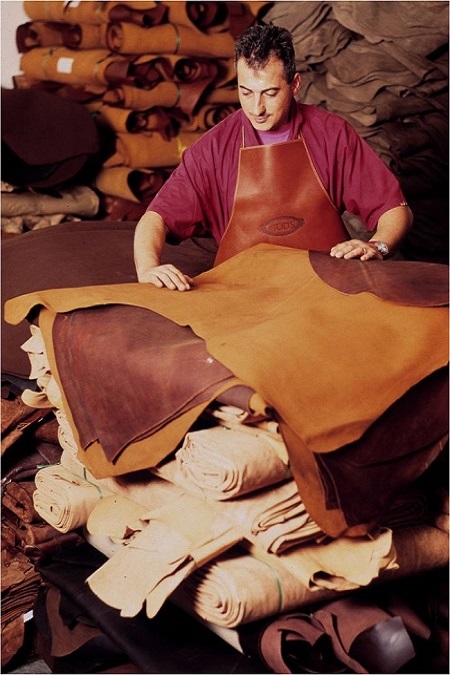
Just a few hours away from Milan, in Brancadoro, a few kilometers from Ancone, also called “the shoe district” in Italy, you’ll find the Tod’s factory, where the entirety of the brand’s shoes are produced. The first ateliers saw the light of day in 1978; they are now integrated into a huge complex that still favors artisanal workmanship. The Gommino is no exception to the rule, and is thus entirely handmade by the brand’s workers.
In this factory, each hide received is first submitted to a scrupulous quality control (cf. picture 1). Indeed, it must be verified that each of the hides perfectly corresponds with the reference model, a leather sample made by the tannery, in order to avoid any difference in color shade between the different series produced from the same model. Next comes a test of the hide’s thickness (cf. picture 2), which mustn’t be too thick to be able to be worked with Tod’s tools, nor too thin to be able to meet the expectations of durability to which each of the brand’s shoes is held. Each hide goes through one final quality control, this time aiming to find any defaults that would preclude a hide from being involved in the fabrication of a Tod’s shoe. Once these preliminary but essential tests are properly carried out, the hides are transmitted to a team of tailors within the factory who’s mission is to cut out the hides by following a predefined model that acts as their guide (cf. picture 3). The cut piece is then sent to assembly, where the different cut-out elements will be sewn together. Each shoe is composed of an average of 25-30 pieces, while the most fantastic pebbled “moccasins” can cross the threshold of over 70 pieces (cf. picture 4).
Now comes the famous stage where the 133 rubber pebbles, never any more, never any less, are inserted, giving the “moccasin” its famous title of Gommino. They guarantee excellent grip in any circumstance; after all, the initial idea was to create an urban shoe by taking inspiration from a driving shoe (cf. picture 5). The shoe must then be shaped through a series of folds, the idea being to utilize a minimum of pieces in order to obtain a high quality handmade shoe (cf. picure 6). The shoe finally requires one last shaping once it’s sewn in order to be definitively formed and so that it no longer requires an interior sole. One noteworthy aspect is the absence of any waterproofing treatment for the sake of letting the hide breath and maintain its suppleness. If the model in question is made of leather, it may undergo a treatment in order to obtain certain color shades or a varnishing. Finally, the shoe is inserted into a box, stuffed with shoetrees, and surrounded by other papers in order for it to arrive in stores in the same condition that it left the factory, as if the shoe were directly deposited on the boutique shelf by the artisans themselves (cf. picture 7).
Beyond these technical aspects, the brand particularly insists upon their artisanal spirit as well as a sense of belonging. Symbolically, owner Diego Della Valle’s youngest son attends the same school as the factory worker’s sons, in Casette d’Ete. The boss likes to remind us that beyond their different roles, they all equally participate in the company’s success. And so, each of the artisans and factory workers that’s contributed to the fabrication of a model will be able to tell you how proud they are to see these shoes worn by an international clientele, and to have contributed to the upkeep if not the advancement of their renown. Roberto, a stylist, sums up the philosophy that internally motivates every employee at the Tod’s factory: “working well with passion and paying attention to the details”.
Leave a Reply