
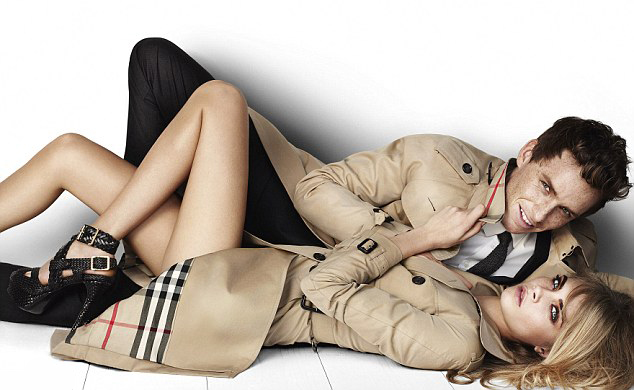
Tartan was once the prerogative of Scottish men, used to make kilts or the wool blankets they threw around their shoulders as well as marking one’s belonging to a specific clan. The width, color, and space between the lines allowed the wearer to be distinguished by class. A tight-knit wool fabric, tartan was adopted by Burberry in the 20s. In 1920, the first version of Burberry’s tartan appeared. Called Nova Check, it was a leitmotiv in its successive collections with white, black, and camel-colored Scottish threads. But it wasn’t until 1924 that Thomas Burberry designed the iconic Haymarket Check, the famous white, black, red, and beige Scottish motif that still marks the brand’s creations today. Haymarket is the London neighborhood where Burberry’s headquarters was installed by its founder, and where it remains even today.
Become the distinctive sign of Burberry, tartan was also used for the first time as a lining for their mythic trenchcoat. It was already considered a prolonging of the style back in the day. Today, Roberto Menichetti, creative director for the brand, can be credited with Burberry’s tartan lining. Burberry’s tartan has definitely become one of the symbols of British chic. It is with this meaning in mind that punks decked themselves in it to show off their rebuttal. In the fashion world, Vivienne Westwood, at the head of the movement, used it in clothing that become a symbol of rebellion and nonconformism. When grunge meets this Victorian fabric, Queen Elizabeth II’s personal tartan is used as a gimmick for rejecting the establishment.
Leave a Reply