
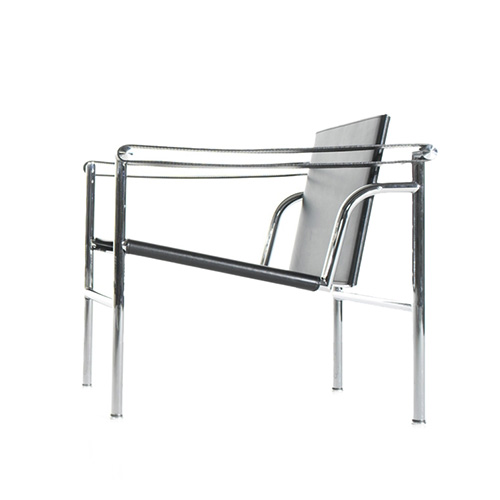
Le Corbusier, Pierre Jeanneret, Charlotte Perriand – LC1
2,712.00 €
Icon-Icon Opinion :
An essential piece of design, first designed in its original version for the Villa Church project in 1928, is a reinterpretation of the English‚ Officers chairs’. It is a quintessence of modern, refined design and a long British tradition.
Name of the Product :LC1
Designer : Le Corbusier, Charlotte Perriand and Pierre Jeanneret
Description : Designed in 1928, LC is a family of seating that has marked the history of design. Designers Le Corbusier, Charlotte Perriand and Pierre Jeanneret have created an armchair that perfectly expresses the characteristic rationalism of modern design.
Materials : Leather, Steel
Related products
-

Wiggle Side Chair – Frank Ghery
955.00 € En savoir +BuyIcon-Icon Opinion :
Frank Gehry was one of the first designers to make furniture out of cardboard, coming up in 1972 with this legendary Wiggle Side Chair. It’s a tribute to the Zig-Zag chair by Rietveld that became iconic!
Name of the product : Wiggle side chair
Designer : Frank Gehry
Description : Architect and designer Frank Gehry is renowned for his use of unusual materials that undergo radical transformations. By creating the “Easy Edges” furniture series, he has given a new aethetic dimension to a material as mundane as cardboard.
Materials : Cardboard, Hard fibre panel
-

Le Grand Hotel et le Café de la Paix
45.00 € En savoir +BuyAuthor: Laure Verchère
Publishing House: Flammarion
Publication Date: September, 2021
During the reshuffling of Paris by Haussmann, the Opera district saw the Grand Hotel and the Café de la Paix emerge. The embodiment of the Belle Epoque style, this 34,000 m2 palace with 458 rooms was renovated in 2019-2020. The Café is a social place where celebrities appear, from Zola to Clinton, Hemingway and Travolta. With the mythical recipes of the Café.
-

Hôtel du Cap-Eden-Roc
75.00 € En savoir +BuyIcon Icon Opinion
A beautiful book with delicious pastel-coloured pages, which explores each sumptuous room of this 150-year-old shelter overlooking the Mediterranean Sea. The Hôtel du Cap-Eden-Roc is a special place — a place that inspired Scott Fitzgerald, a luxurious, enchanting place that has housed great figures of this century… A place immortalised by photographer Slim Aarons as the absolute palace of the Dolce Vita! Dive into the history of this timeless place thanks to hitherto unseen anecdotes, documents and photographs…
Authors: Alexandra Campbell (Author), Graydon Carter (Preface)
Publishing House: Flammarion
Publication Date: April 2021
At the heart of Cap d’Antibes’ magnificent landscape lies a priceless treasure, the Hôtel du Cap-Eden-Roc. A true legend on the Côte d’Azur, this palace has been around for one hundred and fifty years, inspiring its visitors. High ranking aristocrats, painters, directors, actors, poets and photographers, many great names have stayed here and wanted to return regularly. Throughout its history, the hotel has welcomed personalities who have marked the history of art and cinema such as Francis Scott and Zelda Fitzgerald, Pablo Picasso, Marc Chagall, Marlene Dietrich and Rita Hayworth. This mythical hotel is both an exceptional place, a place for extraordinary meetings, and an ideal second home where the sweetness of life is cultivated to perfection.
-

Le style Empire. L’hôtel de Beauharnais à Paris
125.00 € En savoir +BuyIcon Icon Opinion
Even though the history of this building is very interesting, what makes this book so special is that it deals with its interior and furniture… On top of a detailed tour of the main rooms, texts complete the essential information shared on this revered Empire style — decorative paintings, Empire furniture, fabrics and garniture, among other things.
Authors: Jörg Eberling, Ulrich Leben, Francis Hammond
Publishing House: Flammarion
Publication Date: October 2016
This book is the first major monograph devoted to the Hôtel de Beauharnais, today the residence of the German ambassador in Paris, a masterpiece of the Empire style and, for two centuries, a major element of Franco-German history. Built in 1713 by the architect Germain Boffrand, it was in 1803 that Prince Eugène de Beauharnais acquired it and, with the help of his mother, Empress Joséphine, undertook sumptuous works that placed the hotel at the forefront of art history and were at the origin of its reputation. After the fall of the Empire, it became the Parisian pied-à-terre of the Prussian king, then the German embassy, before becoming the residence of the German ambassador to Paris in 1968. Most of the interiors from Prince Eugene’s time have been preserved and this book, thanks to an exceptional photographic campaign, bears witness to the incredible beauty of this exceptional place. As a result of extensive research and restoration work that lasted more than ten years, it traces the history of this building and the destiny of those who lived in it with great documentary wealth.