
Description

34.90 €
Icon Icon opinion
The French Riviera (‘Côte d’Azur’, in French, which literally means the ‘Azure Coast’) got this nickname and won its spurs thanks to artists, aristocrats and cocottes who quickly chose this place as their favourite for their holiday. Nowadays, this chic and socialite taste and lifestyle are conveyed by the luxury hotels of Nice, the capital of the French Riviera… Luxury hotels such as the Negresco and the Carlton, whose one of the towers was directly moulded from one of the Belle Otero’s breasts! This is the kind of story you will discover by reading this beautifully illustrated book!
Authors: Alain Bottaro, Véronique Thuin-Chaudron, Michel Steve, Jean-Louis Panicacci
Publishing House: Gilleta
Publication Date: November 2019
Since the end of the 18th century, Nice, with its modest size, has been popular among foreigners who seek its location mainly for its climate. After it became part of France, the construction of numerous hotels and palaces, as vast as they were elegant, enabled it to welcome royal families and heads of state from all over Europe to holiday on the Côte d’Azur. Brilliant architects built sumptuous residences, where the masterly ornamentation of the facades was matched by a desire for modern interior comfort, which was completed by private gardens and parks, veritable plant paradises and dreams of the Orient. Unfortunately, the First World War spared no one and Nice had to adapt to the scarcity of luxury customers. Gradually, the Belle Époque style gave way to Art Deco: the fashion for apartment-hotels became all the rage. At the end of the Thirty Glorious Years, the hotel industry experienced an unprecedented upheaval: chains and groups became the leading investors in tourism. Since 1980, globalisation has increased the importance of tour operators and has led to a new dimension in the history of the hotel industry. This book, full of illustrations and accompanied by an unpublished historical atlas, was written by a group of renowned specialists (Alain Bottaro, Véronique Thuin-Chaudron, Pierre-André Hélène, Eliane Schor, Jean-Louis Panicacci, Alain Callais, Michel Tschann, François Jouvet and Landy Blanc). It provides a fascinating insight into the hotel industry’s heritage, which is now a permanent part of the city’s soul.

Icon Icon Opinion :
Saskia de Rothschild is to be thanked for bringing together in a beautiful book the history of this Château, which produces the most sought-after Sauternes wines in the world. This book, Almanach Château Lafite 1868, retraces the fascinating adventure of a vineyard which in 2018 celebrated 150 years of vines, wines, encounters, hazards and battles!
Author: Saskia Rothschild (de)
Publishing House: Flammarion
Publication Date: December 2020
Description : Winemakers Éric and Saskia de Rothschild lead readers through 150 vintages of Château Lafite, revealing key moments since the family arrived in 1868, along with scientific and climatic data and visual memories from the château’s archives. Over the past 150 years, six generations of the Rothschild family have attended to the winemaking tradition, developing Château Lafite’s reputation and transforming this classified Premier Grand Cru into a benchmark for fine wine in Bordeaux. Discover how this occurred and what actually lies behind Lafite’s label through stories from the tightly-knit team of men and women who tend to Lafite wines-from vineyard workers to barrel makers, and harvesters to winemakers. A chronology introducing each of the 150 vintages includes informative tasting notes, meteorological aspects, and the grape blends that mark each vintage. An archival gem has been unearthed for each year: from the harvesters’ menu in 1922 to portraits by master photographers like Robert Doisneau, Richard Avedon, and Paolo Roversi. Space to record personal tasting notes allows readers to make this book their own, building their wine knowledge over time.

Icon Icon Opinion :
It is the most prestigious appellation in the world – yet the iconic Romanée-Conti is the fruit of a vineyard that is small in size, but big in history. This is precisely what Laurens Delpech reveals in this book – the short story of the Prince of Romanée-Conti, the man who turned this modest vineyard into a grand cru, like a work of gustatory art!
Author: Laurens Delpech
Publishing House: Flammarion
Publication Date: October 2020
Description :Cousin of the King of France Louis XV, Prince Louis-François de Bourbon-Conti was a patron of the intellectuals of his time such as Diderot, Beaumarchais and Rousseau and a very famous collector of works of art. His stroke of genius was the purchase of the vineyard of the Romanée which was to be called Romanée-Conti. This book reveals the secrets of this mythical wine, object of a real cult by amateurs around the world. After a biography dedicated to the prince of Conti, it allows us, through recent tastings, to define the characteristics of this unique wine that must be placed within the Climates of Burgundy. These climates are terroirs where Burgundian grape varieties are optimally acclimatized. These long-recognized terroirs have enjoyed a unique historical continuity and were inscribed on the World Heritage of Humanity by UNESCO in 2015. To understand Burgundy, it is necessary to know its climates but also to be aware of the climate, that is to say the meteorological conditions of each vintage, because the fact of producing great wines, to the northern limit of maturity of the type of vines used, is sometimes like an obstacle course where nature tries to play tricks on the winemaker. This is why Laurens Delpech reproduces large extracts from the harvest reports published since 1996 by Aubert de Villaine, who runs the Domaine de la Romanée-Conti. This saga of successive vintages reminds us of the difficulty of winemaking. This original, very complete book, which highlights the duality of climates and climate that makes the greatest wines of Burgundy, is written with an alert pen. It is an excellent synthesis of the Romanée-Conti which will also be very useful to those who wish, quite simply, to refine their knowledge and appreciation of Burgundy wines.
Icon Icon Opinion :
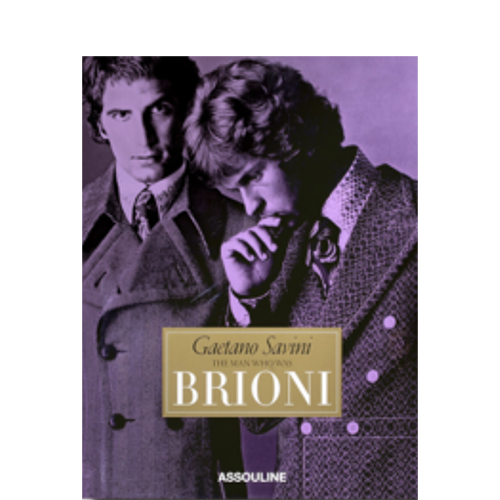
Brioni suits are the sartorial expression of Italy itself… From impeccable James Bond suits to the most elegant of men – you still need to know the story of Gaetano Savini… The man who notably made Milan a fixture on the international fashion calendar. That’s what this book is all about!
Author: Gigliola Savini
Publishing House: Assouline
Publication Date: October 2015
Description :In the age when Savile Row was synonymous with men’s style, an innovative Italian, Gaetano Savini, put his country on the map, forever reinventing menswear. From the first men’s fashion show at Florence’s Palazzo Pitti in 1952 to his craftsmanship influences still evident in today’s styles, Savini was truly a creator on the cutting edge. His legacy as the visionary and designer extraordinaire behind the Brioni luxury brand is celebrated in this spectacular illustrated edition. Highlighting examples of Savini’s innovative cuts, bold colors, and the psychedelic patterns that led the Peacock Revolution of the 1960s, The Man Who Was Brioni includes sketches and newspaper articles illustrating how the man became the legend. Replete with letters, photographs, and personal anecdotes from Savini’s daughter and Brioni heir, this volume details the brand’s far-reaching influence, and how it came to be known as “the Dior of menswear.”

Icon Icon Opinion :
What is the Miyake pleat? Why is Issey Miyake now one of the most sought-after, and inevitably the most hype, names in the world? The house has always been attached to the poetry of movement, and this XL book offers a unique insight into the textile and aesthetic innovations developed by Issey Miyake! A limited edition, it contains a wealth of information crucial to any aspiring fashion designer.
Author: Kazuko Koike
Publishing House: Taschen
Publication Date: April 2016
Description : This limited Collector’s Edition offers a definitive history of Issey Miyake design. Initiated and conceived by Midori Kitamura, the monograph traces Miyake’s material and technical innovations since the earliest days of his career, including the Body Series of the 1980s and such practical, everyday designs as Pleats Please pieces.