
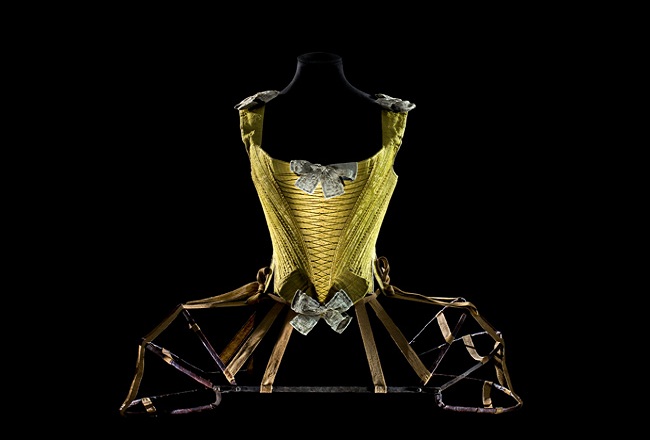
This exhibit illustrates the indiscreet story of the silhouette. It invites you to discover and understand the behind-the-scenes of the garment. As monsieur Denis Bruna, curator of the exhibit, so justly points out, “the history of the garment and fashion has not been focused on these hidden devices, that were considered as futile or vulgar.”
As soon as you get into the exhibit space, an intimate, fleecy ambiance imposes itself as the light sifts in. Of course, this is for conservation purposes, but it also fits perfectly with the theme. The topic is set up around various types of underwear: padded zippers, whalebone bodies… approached from their historical, social, and symbolic contexts. The judicious choice of modern reproductions based on the originals and the use of automats allow for a better understanding of the ingenious mechanics that characterize the majority of underwear.
It is generally agreed upon that fashion was born in the Middle Ages, more precisely in the 14th century. In that era a clear differentiation between male and female fashions emerged, but the most remarkable was the development of an evolutionary cycle for the silhouette. Georges Duby, in his book L’Europe au Moyen-Age wrote: “haute couture disguises the body, envelops it in the unreal, alternately masks the body’s attributes, feminine and masculine.” The garment from then on modeled the anatomy more than it highlighted it. “So, the natural body doesn’t exist; there is indeed a cultural body, designed by a silhouette characteristic of an instant.” The emblem of this constrained, modeled body is the corset. This word appeared in the 14th century to designate a dress, a bodice that was precisely adjusted to be worn over the tunic coat. In constraining the waist, it becomes a tool of the Western female silhouette traditionally based on highlighting the breasts, the waist, the hips, and the buttocks. Underlying this silhouette, the role that lies with the woman shines through: a fertile mother, a docile receptacle. As for the man what with his virility, it’s his build, his member, that are exalted. Even though they’re meant to be hidden underneath clothing, underwear have been sources of creation for numerous contemporary couturiers. Jean-Paul Gaultier’s iconic cone bra or the wedding dress from his Fall/Winter 2008-2009 haute couture runway, where the crinoline cage became a veil, are all reinterpretations, appropriations of this forgotten dressing room. In 1997, Rei Kawakubo spiritedly entitled her Spring/Summer collection “Dress Meets Body – Body Meets Dress” and questioned this uniquely Western tradition by distorting the models’ bodies to add padding in inopportune places.
Upon seeing these underwear, certain of which were borrowed from torture devices, the temptation to let out a sigh of relief is constantly present… But the exhibit perfectly concludes by pointing to the revival of sculpting underwear that have proudly shown up in the past few years on the female lingerie market… but also in mens’ versions! The methods may be different, but fashion continues to make the body…
La Mécanique des Dessous, Une Histoire Indiscrète de la Silhouette
5 July–24 November 2013
Tuesdays to Sundays from 11 a.m. to 6 p.m. / Closed on Mondays.
Les Arts Décoratifs, 107 rue de Rivoli, 75001 Paris
Leave a Reply