
In Milan, a house does not become iconic simply because it owns a recognisable logo. It becomes iconic when it can carry a gesture, a silhouette or an attitude through time, then shift it into a new era. This Spring/Summer 2027 Fashion Week unfolds precisely in that space. At Prada, Gucci and Bottega Veneta, historical codes are not repeated. They are moved, challenged and made desirable again.
Milan Fashion Week is never merely a sequence of runway shows. It is a city watching its own legends in motion. This season, memory is at the centre of the conversation: how can an archive remain alive without turning into a display case? How can a signature evolve without losing its character? The strongest houses answer through clothes, but also through staging and a particular idea of Italian luxury.
At Prada, the answer begins with the skirt. Long part of the house’s vocabulary, it becomes a site of experimentation: layered, contrasted and personalised. The clothes retain the intellectual precision associated with Miuccia Prada and Raf Simons, yet refuse any fixed formula. Proportions shift, functions overlap and each look is built in layers. Prada does not impose a uniform. It offers a way of thinking about personal style that is disciplined, free and unmistakably its own.
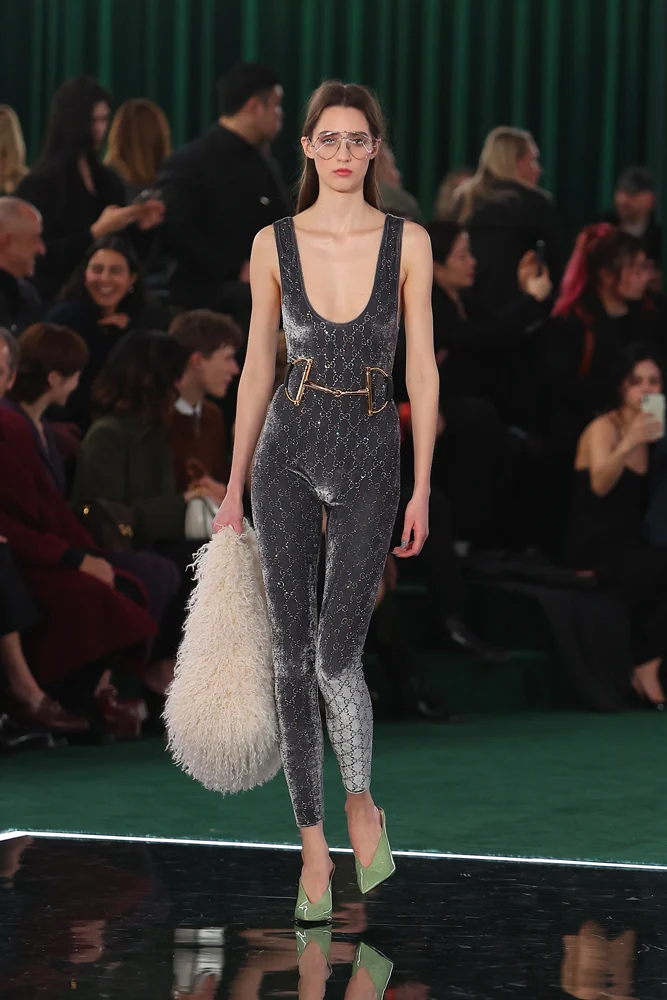
Gucci turns memory into narrative. Demna stages the show as a Gucci store taken to an almost surreal extreme, somewhere between a boutique and a film set. The idea is clear: the house codes do not live only on the runway. They belong to characters, purchases, memories and a certain appetite for pleasure. Nineties glamour, a new relationship to the body, cult accessories and Florentine eccentricity meet in a proposal that prefers collision to nostalgia. Here, an icon is never fixed. It becomes a character to be reinvented.
At Bottega Veneta, Louise Trotter favours a different form of radicality: movement. Intrecciato, leather and handwork are never treated as decoration. They shape a more fluid, more spacious silhouette, creating air between the body and the garment. It is a quiet vision of luxury, but never a passive one. Bottega Veneta’s signature lies in the quality of a material, the precision of a fold and the exact weight of a bag. This season, those signs feel even more alive because they are designed to accompany the body rather than constrain it.
Across these three houses, Milan reminds us that the great signatures need risk. Their strength does not lie in the reassuring repetition of a monogram or a cult object. It lies in their capacity to take what everyone already knows and make it suddenly unexpected. A Prada skirt, a Gucci world, a Bottega Veneta weave: each element carries a shared cultural memory, but each finds a new present here.
For ICON-ICON, this is the essential lesson of Milan Fashion Week. An icon is not an object that survives time by remaining unchanged. It is an object, a house or an attitude that moves through time because it accepts transformation. In Milan, heritage does not look backwards. It moves forward with enough mastery to remain recognisable and enough daring to keep surprising us.
Leave a Reply