
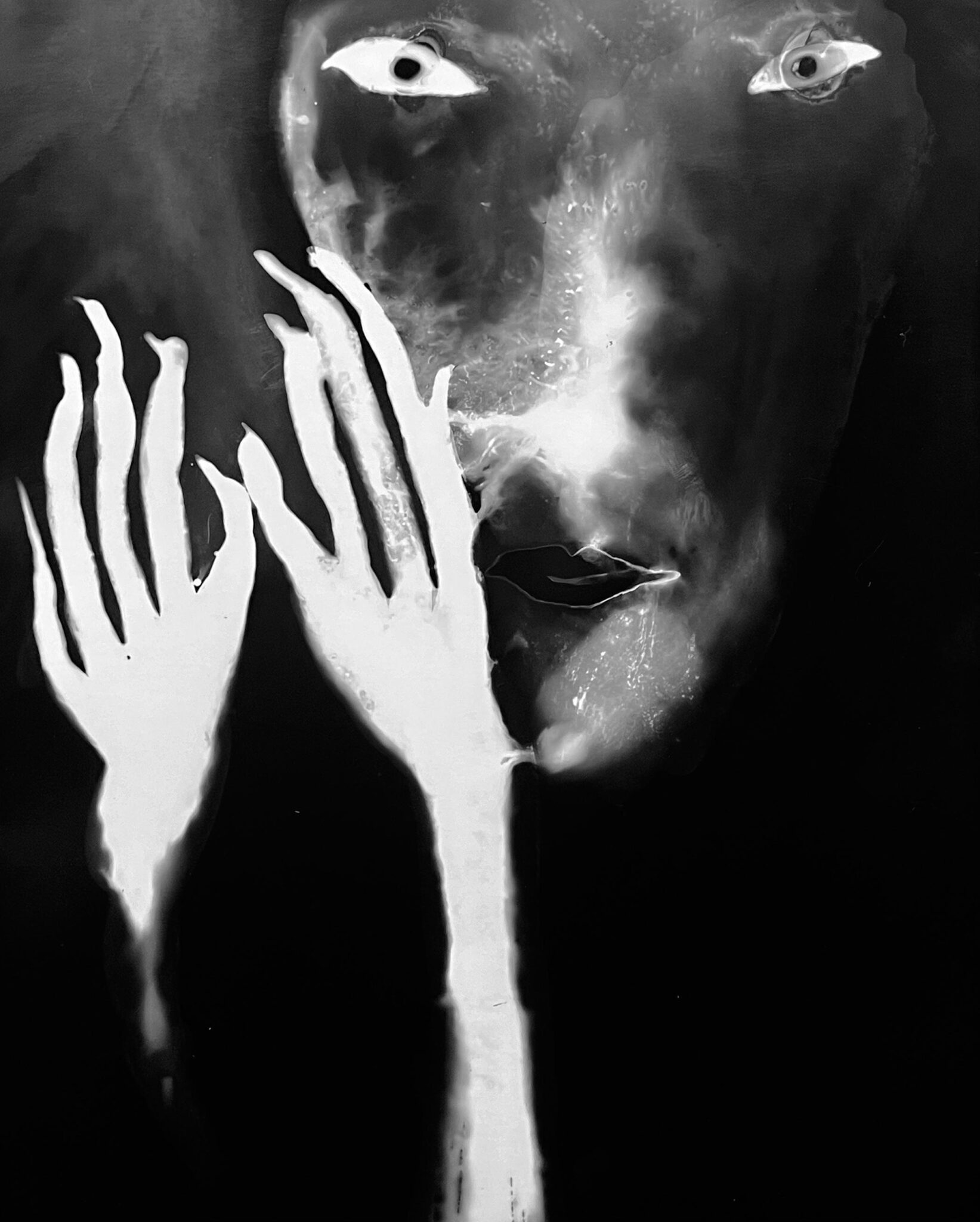
Until 10 October 2026, Galerie La Lison, nestled within the prestigious tattoo parlour La Bête Humaine, presents Ai Huang: Kabrala, the artist’s first solo exhibition in France. Through a series of silver-gelatin self-portraits reworked with concoctions of chemical products, Ai Huang moves photography towards matter, accident and sensorial experience.
These images do not document a face. They follow a presence in the process of changing. On the surface of the negative, the body becomes a shifting zone in which light, chemical baths and time each leave their mark. Kabrala asks us to look slowly, and to accept that a portrait never reveals itself all at once.
A Body That Refuses To Be Fixed
Ai Huang’s images do not seek likeness. They begin with the body, but refuse to lock it into a stable figure. In the darkroom, the print becomes a site of transformation: developer, fixer and inks act upon its surface, shifting contours and bringing forth a presence rather than a portrait.
Valérie Dufour, the exhibition’s gallerist and curator, captures this position precisely: “Ai Huang does not simply show herself; she commits herself.” For Dufour, these photographs “are not about restitution, but transformation.” Ai Huang’s gesture opens a space in which identity becomes mobile and fragmentary, continually remaking itself.
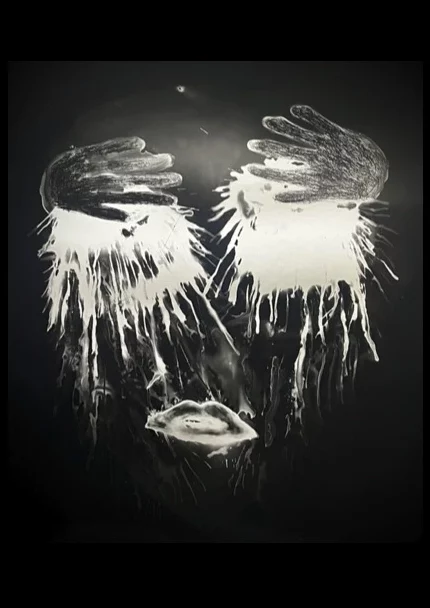
This practice is also rooted in a very concrete relationship with matter. The print is not the conclusion of a photograph being taken; it is the moment when the image can still tip into something else. Accidents, drips and dissolutions are not erased. They become the visible traces of an experience inscribed within the photographic process.
Photography As Encounter
Here, analogue photography is not merely a technique. It brings its own temporality, uncertainty and physical relation to the image. “Every gesture, every contact, every duration is inscribed in the image,” Ai Huang explains. “When I handle the developer and fixer, I am not seeking to fully control the result, but to create the conditions for an encounter.”
This attention to process gives Kabrala its particular density. The works appear to hold the traces of their own emergence: chemical effects, passages of light and areas of dissolution. The body becomes less a subject than a material traversed by whatever transforms it.
What stands out is the tension between control and surrender. The artist prepares the conditions in which the image may emerge while leaving the process its own autonomy. The viewer is therefore not confronted with a definitively stabilised image, but with the trace of a contact: something that has resisted the desire to control everything.
Entering An Inner World
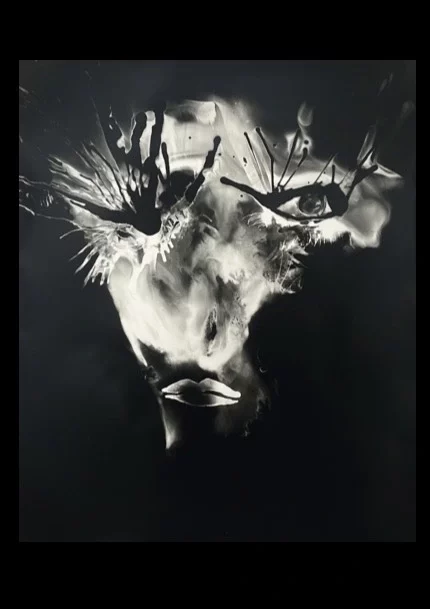
In Valérie Dufour’s words, “the body becomes a material, a place of inscription; the image, a space of experience.” The sensuality of these photographs does not depend on the frontal display of a face or silhouette. It forms in textures, withdrawals and the distance between what is shown and what remains elusive.
Ai Huang’s relationship with the darkroom is intimate. She describes it as “a door into my world”, a space both secret and liberating. From this experience, the artist develops a practice that accepts disturbance and lets images retain their capacity to drift.
Kabrala presents a photography that wavers, changes and asserts itself beyond overly neat categories. At Galerie La Lison, Ai Huang brings together a body of work inhabited by trace, desire and metamorphosis: self-portraits that never close their subject off, but open it to what may still come to pass.
Valérie Dufour extends this play between photography and painting: “I love the moment when a visitor approaches a work, squints, nods, and wonders whether they are looking at a photograph or a painting. I always hesitate between giving the game away and letting the mystery hover. Doubt is a wonderful state of mind.”
Looking As A Space Of Experience
Before these works, looking is not simply a matter of recognising a figure. It must adjust to shadowy areas, folds in the paper, appearances and disappearances. The image demands an active attention: what we think we see shifts as we move closer, as though the photograph always keeps part of its process secret.
This instability gives the exhibition its own rhythm. Within Galerie La Lison, each print asserts its presence without exhausting its mystery. Kabrala does not offer a series of sealed images, but a group of living surfaces crossed by time, experience and the desire to let matter answer in turn.
The visitor becomes part of this oscillation between what is revealed and what still escapes.
Practical Information
Ai Huang, Kabrala
Thursday 3 September to Saturday 10 October 2026
Galerie La Lison, 5 rue Pierre Chausson, 75010 Paris
Leave a Reply