
Description

81.00 €
Icon Icon Opinion :
It is the working method of François Truffaut’s genius that is deciphered in this book – in great depth, this book returns above all to François Truffaut’s approach to cinema… A cinema marked by a passion, an interest in male-female relationships and a fascination for the age of childhood.
Author: Carole Le Berre
Publishing House: Cahiers du Cinéma
Publication Date: 9 Octobre 2014
Description : Among the abundant literature devoted to François Truffaut, a work on his working method from his archives was missing. Carole Le Berre’s patient investigation of the entirety of an unhoped-for working documentation allows her to access the universe and the creative process of a filmmaker as rarely as possible. Because Truffaut wrote a lot, covered his scripts with handwritten notes, and had a passion for keeping everything, the reader can witness, as if on the sly, the very movement of the elaboration of the work.
We find the still living traces of a mind in constant activity, as if we were catching a filmmaker at work, we discover his secrets of fabrication, we follow the emergence of an idea, the sketch sometimes of a mise en scène, the birth of a film. One has the impression of knowing everything about Truffaut, and yet, this book allows us to discover him from a new angle and to experience even more the obstinacy and coherence of his work.
Nothing could be further from the truth than the legend that Truffaut, the irascible critic, the gravedigger of French quality, had become a settled filmmaker. The subjects of his films, such as they are brought to light here, the violence that emanates from them, the profound savagery of the characters show, on the contrary, how much this received idea is a form of blindness. Truffaut’s cinema never ceases to play with the discrepancy between an anodyne appearance, the amiable mask of entertainment, and the ball of savagery that runs through it and emerges in bursts.
It is from this contradiction between the power of the fantasies he releases and the will to be accepted that he builds his cinema. And it is this need to be recognized and accepted, similar to the desire of his mirror character played by Jean-Pierre Léaud, Antoine Doinel, to enter families, which is at the origin of the misunderstanding that would have us believe in his wisdom, in the unanimity of his cinema.
The organization of the book is chronological and each chapter approaches a film from an angle that highlights an aspect of Truffaut’s method. An abundant iconography enriches the author’s discourse and many unpublished documents are reproduced here, now accessible to fans of Truffaut’s films.

Icon-Icon Opinion: What did a Dior fashion show look like in the 1950s? How did John Galliano romanticize and narrate the iconic turning point of the house in the 90s? For the first time ever, this book collects all of Dior’s haute couture collections, including the ready-to-wear collections after the arrival of John Galliano – and it is an indispensable bible for all fashion aficionados. Both the common parades and shows today find their source in this soaring vision!
Authors : Adélia Sabatini, Alexander Fury
Publishing House: La Martinière
Publication Date: 2017
Description :The triumph of an eternal house, seventy years after its spectacular first show.
On February 12, 1947, a young house named after its founder, Christian Dior, presented a spring-summer haute couture collection in a Paris still in the grip of winter cold. The creations were shown in a salon freshly painted in dove gray at 30 Avenue Montaigne, a historic and mythical address. This is the novelty that Dior symbolizes for fashion in general, and for Paris in particular. These codes, this visual language have fascinated the many successors of the designer: Yves Saint Laurent, Marc Bohan, Gianfranco Ferré, but especially John Galliano, and since 2017 Maria Grazia Chiuri. Their task has been, season after season, to find a new voice through the vocabulary of Dior.
Icon Icon Opinion :
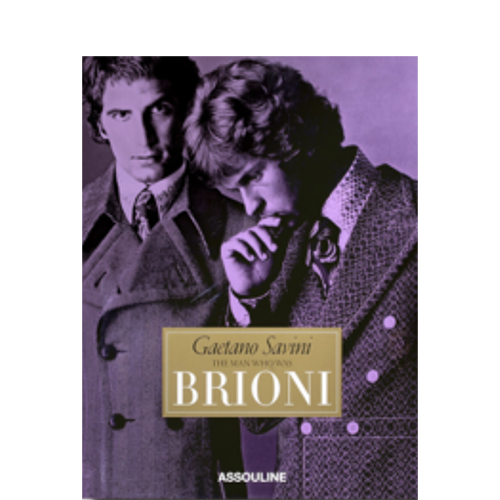
Brioni suits are the sartorial expression of Italy itself… From impeccable James Bond suits to the most elegant of men – you still need to know the story of Gaetano Savini… The man who notably made Milan a fixture on the international fashion calendar. That’s what this book is all about!
Author: Gigliola Savini
Publishing House: Assouline
Publication Date: October 2015
Description :In the age when Savile Row was synonymous with men’s style, an innovative Italian, Gaetano Savini, put his country on the map, forever reinventing menswear. From the first men’s fashion show at Florence’s Palazzo Pitti in 1952 to his craftsmanship influences still evident in today’s styles, Savini was truly a creator on the cutting edge. His legacy as the visionary and designer extraordinaire behind the Brioni luxury brand is celebrated in this spectacular illustrated edition. Highlighting examples of Savini’s innovative cuts, bold colors, and the psychedelic patterns that led the Peacock Revolution of the 1960s, The Man Who Was Brioni includes sketches and newspaper articles illustrating how the man became the legend. Replete with letters, photographs, and personal anecdotes from Savini’s daughter and Brioni heir, this volume details the brand’s far-reaching influence, and how it came to be known as “the Dior of menswear.”

Author: Matt Anniss
Publishing House: L’Imprevu-Adulte
Publication Date: September 2017
Rediscover the great figures and superstars of F1, from the 1950s to today, from Juan Manuel Fangio to Sebastian Vettel, through Alain Prost, Ayrton Senna or Michael Schumacher, relive the eventful careers of these virtuoso drivers.

Author: Tonne Goodman
Publisher : Harry N. Abrams
Publication Date: 2019
Description : Throughout her illustrious career, Tonne Goodman has made the famous stylish and the stylish famous. The Vogue fashion director has not only shaped the way women dress and see themselves, but she has also created a nexus in which the worlds of celebrity and style continually collide. Now, in Point of View, Goodman’s life and career are explored for the first time. Organized chronologically, this book charts Goodman’s career from her modeling days, to her freelance fashion reportage, to her editorial and advertising work, through to her reign at Vogue. The editor’s recollections of some of the world’s greatest photographers, models, celebrities, and designers of our time are illustrated throughout, with behind-the-scenes fashion photos and shots of Goodman’s personal life.